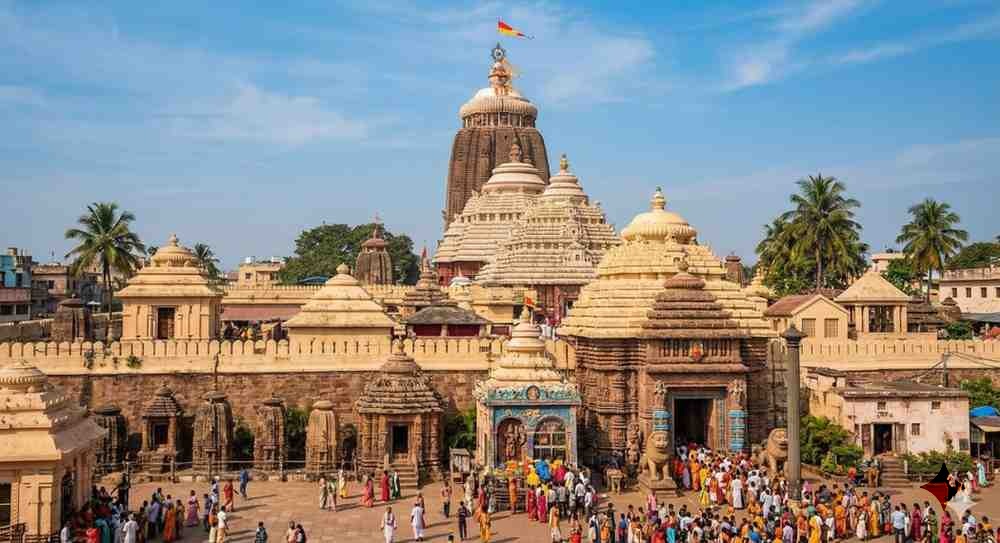
In the city of Puri, on the eastern coast of Odisha, there is a kitchen that has not gone cold in over a thousand years. It is called the Ananda Bazaar — the Marketplace of Joy. Every morning before dawn, five hundred cooks begin work. By noon, the kitchen has produced enough food to feed between ten thousand and one hundred thousand people. By evening, every single grain of rice, every last drop of dal, every piece of bread is gone. The kitchen closes empty. Tomorrow it begins again.
This is the kitchen of the Jagannath Temple in Puri — one of the four sacred dhams of India, and the spiritual heart of Odisha. Lord Jagannath, the Lord of the Universe, has been fed here every single day since the temple was consecrated in the twelfth century. What is offered to him becomes Mahaprasad — sacred food, blessed by his presence, available to all who arrive. King or sweeper, Brahmin or untouchable, foreign pilgrim or local child: the Ananda Bazaar feeds everyone without exception, without hierarchy, without question.
No one who comes to the kitchen of Lord Jagannath leaves hungry. That is not policy. It is faith made edible.
The Chhappan Bhog — 56 offerings
Each day, the temple priests prepare the Chhappan Bhog — 56 distinct food items offered to Lord Jagannath at different hours of the day. Rice preparations, dal, curries, sweets, chutneys, fried breads, coconut desserts, and more. Each item has a precise recipe, a prescribed sequence, a sacred purpose. The variety is not extravagance — it is devotion expressed through the full range of what a kitchen can produce.
These 56 offerings are cooked in earthen pots, stacked one on top of another over wood fires. The bottom pot touches the flame. Every pot above is cooked only by the heat rising from below. The extraordinary thing — witnessed by food scientists and temple devotees alike — is that every pot in the stack is cooked perfectly at the same time, from bottom to top. No scientific explanation has fully satisfied this observation. The faithful have their own answer.
What Mahaprasad means
Mahaprasad is not simply leftover temple food. In Odia theology, when food is offered to Lord Jagannath, it is transformed. The act of offering purifies it, blesses it, and gives it a quality that ordinary food — however skilfully cooked — cannot possess. To receive Mahaprasad is to receive grace. To share Mahaprasad is to dissolve caste, rank, and distance in the act of eating together.
This is why Mahaprasad has always been eaten sitting on the ground, in lines, with no distinction of who sits next to whom. The founder of a dynasty and the pilgrim who walked for three weeks from a remote village eat the same food, from the same kitchen, side by side. The meal is the equaliser. The kitchen is the sacred space.
The oldest restaurant in the world
Food historians and anthropologists have called the Ananda Bazaar of the Jagannath Temple the world's oldest continuously operating restaurant — a claim not made lightly. For over eight hundred years, without interruption, this kitchen has opened before dawn, cooked for thousands, fed them without charge, and closed empty. Wars, famines, floods, colonial rule — none of it stopped the kitchen. The fires kept burning.
Where Bhabhi begins
Bhabhi is an Indian kitchen. Our cooking carries the flavours and methods of Odisha — a coastline cuisine shaped by the Bay of Bengal, by paddy fields, by turmeric ground in stone mortars, by mustard and coconut and the patience of women who cooked before electricity existed in their villages.
When we started Bhabhi in Hsinchu, we were thinking about something more than a restaurant. We were thinking about what it means to cook for people who are far from home — engineers and families who moved here for work, who miss a specific smell from a specific kitchen in a specific city they left behind. We wanted to feed them the way the Ananda Bazaar feeds pilgrims: without fuss, without performance, with everything we have.
The fortnightly buffet at Bhabhi is our version of this. Not sacred in the temple sense — but shared in the same spirit. Everyone sits together. The kitchen sends out everything it has made. Nothing is held back.
We keep a small image of Lord Jagannath in our kitchen. Not for luck, not for display — as a reminder of where our idea of cooking comes from. The tradition that says: if you are here, you will be fed. If you are hungry, that is reason enough.
Come and eat
Bhabhi is open Tuesday through Sunday in Hsinchu City. Our fortnightly buffet — a full spread of North Indian dishes, no menu, no ordering — is held every second Saturday. You can reserve via WhatsApp. Or simply walk in. We will feed you.


